
Technology
Four disciplines, engineered as one architecture.
Passivia treats clinical, industrial, and agricultural deployments as instances of the same problem: trustworthy inference at the edge of a physical process.
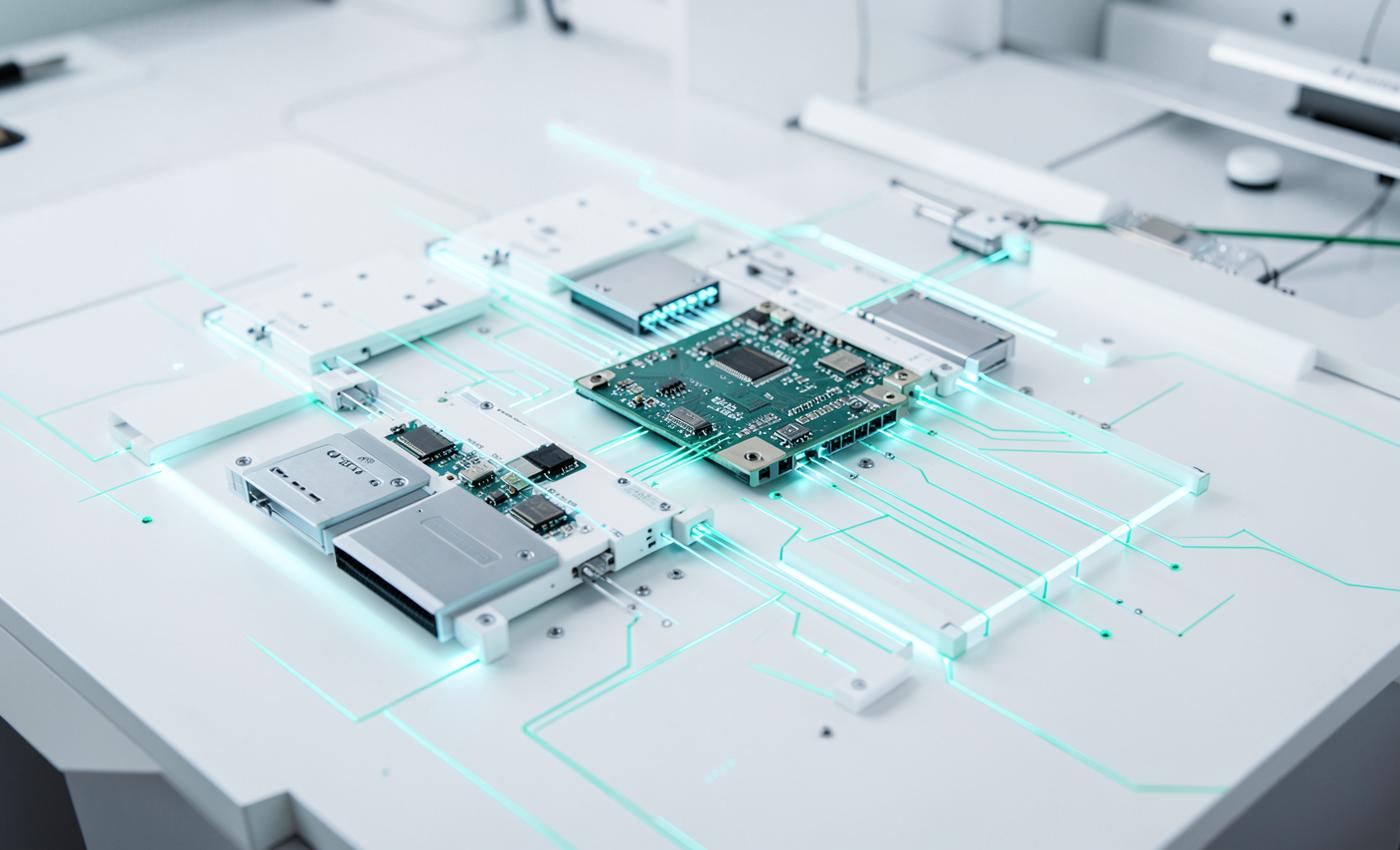
Embedded Edge AI
Deterministic inference on constrained hardware, with signed model provenance and bounded latency budgets that hold under fault conditions.
- Quantised model pipelines with per-release latency envelopes
- Measured boot and hardware root of trust on every module
- Air-gap capable operation with local buffering
Biomedical Computer Vision
Vision systems built for regulated clinical environments, where annotation must be reproducible, auditable, and explainable to a specialist.
- Morphokinetic annotation validated against blinded expert panels
- Confidence gating with mandatory clinician review paths
- Full frame-level traceability from capture to conclusion
Industrial IoT
Plant-grade sensing and control integration that respects existing automation hierarchies rather than replacing them.
- Modbus TCP, OPC UA, and MQTT interoperability
- Supervised setpoint writes with constraint enforcement
- Deterministic failover to native plant controllers
Enterprise Security
Zero-trust device enrolment and customer-controlled key custody across every deployment, clinical or industrial.
- End-to-end encrypted telemetry with customer key custody
- Signed, versioned firmware and model artefacts
- Segmented network posture aligned to IEC 62443
Reference architecture
From instrument to regulatory assurance.
Every deployment resolves to the same five layers. Sector specificity lives in the models and controllers, not in the structure.
Sensing layer
Optical, chemical, mechanical, and environmental instrumentation with per-channel calibration.
Edge compute layer
Embedded accelerators executing signed, versioned models inside a bounded latency envelope.
Control & decision layer
Deterministic controllers and confidence-gated decisions with human override authority.
Integration layer
HL7/FHIR, OPC UA, Modbus TCP, and MQTT bridges into existing enterprise and plant systems.
Assurance layer
Immutable telemetry, model provenance, and audit trails supporting regulatory submission.
Interactive specifications
Explore specs, architecture, and compliance by system.
IVF Watch
An in-incubator monitoring system that fuses time-lapse imaging with environmental telemetry to deliver deterministic morphokinetic annotation and deviation alerting without moving patient data off-site.
Specifications
- pH level stability
- 7.27 ± 0.02 continuous, 1 Hz sampling
- Gas concentration alerting
- CO2 6.0% / O2 5.0%, deviation alarm < 3 s
- Incubator array coverage
- Up to 16 chambers per edge node
- Time-lapse imaging
- 7 focal planes, 10-minute interval
- Chain-of-custody logging
- Biometric operator sign-off, append-only ledger
- Grading concordance
- 99.2% vs senior embryologist panel
Architecture stack
In-incubator optics
Sealed multi-focal imaging module with thermal isolation.
Edge inference node
Deterministic morphokinetic annotation with bounded latency budget.
Environmental telemetry
pH, CO2, O2, temperature and humidity fused into one drift model.
Chain-of-custody ledger
Biometric identity bound to every specimen event, tamper-evident.
LIS integration
HL7 / FHIR exchange with the clinic information system.
Compliance standards
- ISO 13485
- IEC 62304
- HIPAA
- GDPR
- ISO 27001
Technical review
Bring your architecture team.
We run joint technical reviews covering integration surface, security posture, and validation evidence.